
The Roof and the Roof Windows
By Ian · first-hand account · 8 min read
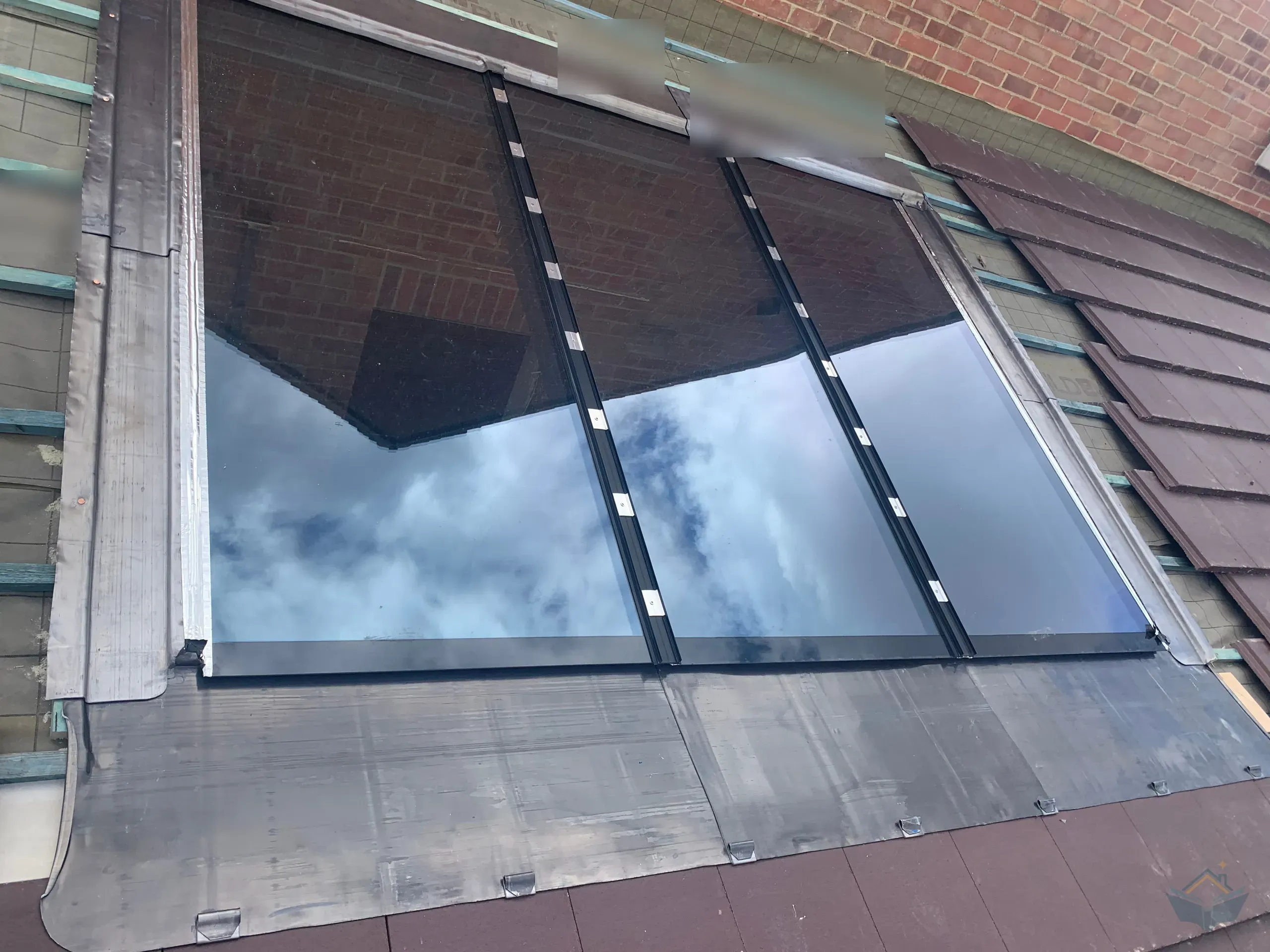
Two words on a supplier's drawing cost me four months and a leak I never fully closed out. The words were "by Others".
The rooflights came from the company first lined up for the bifolds as well, before the order was cut back to the roof windows alone. The order was placed at the end of March 2022 and paid for in two instalments that spring, which a small refund later brought to £11,748 including VAT. Two lean-to units for the rear pitch, 3510mm and 2682mm wide, grey solar glass, fitted at the end of August. That bought the units and a crew to set them into the opening, and nothing at all that keeps water out around them. The bifold doors came from a different company, and the supplier failure attached to those is the structure chapter's story.
Page four of the order is a cross section through the junction, and every label on the roof side of it ends the same way. Tiles by Others. Tile battens by Others. Ply and or timber for lead support by others. Code 5 Lead By Others. I read that page when I signed it and took it for a materials list. It is a line drawn through the middle of a detail, and everything on my side of the line needed a tradesperson I had not yet found.
Warning
On a rooflight order the glass is the easy part. Find the drawing that shows how the roof covering meets the frame, count the labels reading "by others", and price that work as a separate job before you sign. Then ask your builder to name the person doing the lead, and ask that person whether they have dressed lead around a rooflight before.
The roof itself had been closed in a month earlier, membrane on and temporary battens holding it down, with no tiles yet.
One detail from that day matters much later. The specification named a particular high performance breathable membrane and a cheaper one went on instead. Nobody raised it at the time, and it became the closing argument in a disagreement eight months away.
The roofer, and the lead he bought
The scaffold was going up over that weekend and was up by the Monday. I had the roofer's number from my builder, and on Saturday 10 September I sent him the structural opening drawing so he could see where the lead flashing went before he was standing on the roof. He said he would have a good look at it over the weekend and wrap his head around it. Tiling ran on the 12th and 13th. On the 14th the builder bought £686.08 of lead, to the roofer's own requirements.
Plywood went on around the openings first, because lead needs something solid to sit on rather than a void between rafter and window frame. That plywood and more lead came in on a separate £290 invoice.
Then the leadwork defeated him. My recollection of the conversation is that he told me it was too complicated for him. What the record shows is that lead was bought for him on the 14th, and that by the 16th I was messaging an independent lead specialist.
The specialist, and the second grade of lead
The guide for this: Snagging Checklist
He came out on the 17th and leaded the smaller window on the 18th for £250 in cash. He also left me a list of corrections to the roofer's work: an eaves tray to add, tiles that needed nailing down, a tile course under the larger window sitting in the wrong place. His opinion of the man who had laid them was shorter than the list. The politest version is that he did not think he should be on a roof.
On the 20th the roofer told me he could not finish, because he had been in a car accident. He agreed to come back next morning to cut the tiles under the larger window ready for lead, and warned me that cutting weakens them. He was right about that. He cut them early on the 21st, another £106.85 of lead was bought, and the specialist leaded the larger window the same day for £150. A lot of tiles broke in the process.
The drawing had specified Code 5 lead. What went onto the larger window was not the same material. The windows sat low in the roof plane and there was not the room to bend and dress lead that thick into the space available, so a different grade went on. My photograph note from the day reads that the new lead contains more tin, so it looks different. It does, if you know to look.
Thirteen messages out, two back
13 of 15
Fifteen messages passed between me and the roofer over the month he was on my roof, and thirteen of them are mine. Three separate days went on asking whether he was coming that day. What time are you coming over. What time will you be here today. The last message in the thread is mine as well, asking whether he had any patination oil for the lead at the top of the window, and it was never answered.
The pattern was visible before I let myself see it. He did not turn up on the day the rooflights were installed at the end of August. On 24 September he arrived with an assistant, added the eaves tray and could not finish because there were no tiles: the builder had not collected them and the merchant had closed. A 300mm by 6m roll of window lead went missing in the same period and was never accounted for.
The gap at the top
Early in October a second layer of lead went on above the windows, with tiles cut to suit. My note from that day records large gaps around the windows and that I was unhappy with how it looked.
On 11 October the tops leaked. The specialist came out and gave me the correct fix: a second cut course of tiles above each window, so any water past the first has at least 300mm to travel before it can get in. He also made clear he did not want the roof side of the job, in case anything else up there came back on him later. It was one more person telling me the problem belonged to somebody else.
Five days later he asked whether the roofer was coming back to sort the tiles. The roofer had replaced one broken tile and would do no more. I wrote back that I was frankly exhausted dealing with him.
Two days after that my wife and I picked the simpler option: a roll of expanding foam strip along the tops rather than another round of tile cutting. £78.75 of material, ordered on the 19th, delivered on the 24th. The specialist fitted it with mastic between the layers of lead on the 25th for £250. He agreed it was simpler and less costly than doing it properly. That is a trade I made with my eyes open, and the one decision here I would take back.
The oil nobody applied
On 8 October I asked the roofer whether he had any patination oil he could wipe around the lead at the top of the window. There is no reply under that message.
New lead oxidises. Left bare through its first rain it goes chalky white and washes that white down whatever sits underneath, which here is a large pane of grey glass. The oil goes on the same day the lead is laid. The photograph at the top of this chapter is the first window on 18 September, oil freshly applied.
When the specialist was up there on 25 October fitting the foam, he found that patination oil had never been applied to any of the roofer's lead. He put it on himself. By then the lead above the windows had already started to go white, and it does not come back. His own two windows had been oiled at the time, which is why he had told me a fortnight earlier that it had been done already. He was answering for his own work. Nobody was answering for the rest.
Tip
Patination oil is a same day step, not a snagging item. Confirm it before the leadworker comes off the roof, and photograph the lead with the oil on it. Three years on there is some marking on ours, which is luck rather than management.
December, January, and an argument nobody won
On 20 December a small leak appeared at the bottom of the larger roof window. My guess at the time was water getting behind the lead on the bottom lip. The specialist came back two days later. On 9 January the patch was still getting wet every time it rained.
His diagnosis had moved on. He now thought the roof had no ventilation: the membrane was not breathable, it should have been vented top and bottom, condensation was finding its way in, and the only fix was to start again. I pushed back. The wet patch was under one window, in one spot, and only ever after rain. The architect had looked at the membrane that went on and said it would be alright. Neither of us shifted.
I never settled it. The specification did name a different membrane, which supports his reading. The leak was localised and driven by rain rather than by cold nights, which supports mine. What is certain is that the argument was only possible because nobody checked the membrane against the drawing on the day it went on, and by the time it mattered it was under tiles.
What the junction cost
Outside the rooflight order, closing that junction cost £1,811.68. That is £686.08 and £106.85 of lead, a £290 invoice for lead and plywood, £78.75 of foam strip, and £650 across three visits by the lead specialist. The roofer himself was never paid by me directly: his labour ran through the builder, whose invoice charged £1,480 for the tiling.
Against the build as a whole it is a small number. It is the one I resent most, because all of it went on doing a job twice.
There is a photograph of that window taken from inside the finished kitchen a few months later, and what I wrote under it still stands: I just wish they had sat slightly higher up so we could have tucked the lead under with more certainty. Rooflight height gets fixed months before anyone thinks about lead, by whoever forms the opening, and nobody on my build presented it as a leadwork decision.
Working through the same stage on your own build? The structure branch covers roof coverings, flashings and the rooflight junction as a sequence of tasks rather than a story, including what to agree with your builder before the scaffold goes up. Start at the structure phase guides.
Frequently asked questions
Do this phase on your own build
Step-by-step guidance for the tasks this chapter covers.
Want the numbers behind this build?
Every invoice from this extension, category by category, in the spreadsheet used to track it. Reuse it for your own budget.
Get the cost ledgerPlanning your own extension? The Access Pass covers the same ground as a step-by-step guide you can work through.